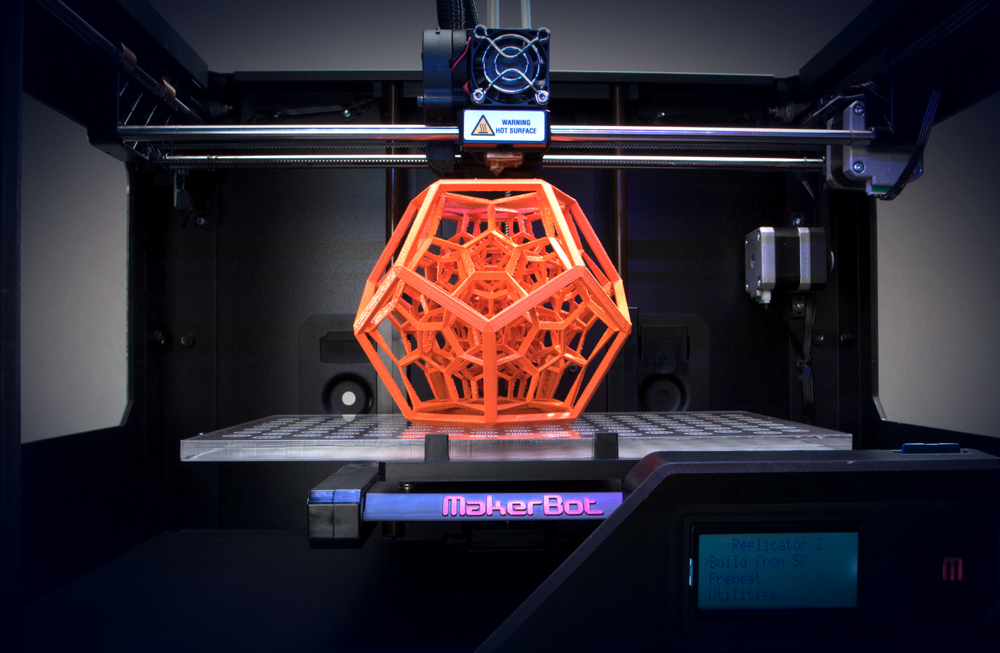
3D printing is used for all sorts of neat stuff. Here's a list:

Apparel: Fashion designers are using 3D printing to make shoes and dresses. New Balance makes custom printed shoes for athletes. Custom glasses frames are becoming popular.
Automobiles: Swedish super-car manufacturer Koenigsegg announced the One:1, which has many printed components.
Chemistry: Chemists can 3D print chemical compounds. Research is being made to see if medicine and food can be printed.
Construction: Building components can be printed. A house is being printed in Amsterdam, and the Sinterhab project is looking into building lunar bases using lunar soil.
Distributed manufacturing: People can download templates for items to print.
Domestic use: If a person owns a 3D printer, they can design or download templates and print things.
Education and research: 3D printing can be used to teach engineering and architecture. It can also be used to print cross-sections of organs of the human body and other animals for study.
Environmental use: In Bahrain, large printers are being used to print coral reef components out of a sandstone-like material to help polyps regenerate coral reefs.
Medical: "3D printing has been used to print patient specific implant and device for medical use. Successful operations include a titanium pelvis implanted into a British patient, titanium lower jaw transplanted to a Dutch patient, and a plastic tracheal splint for an American infant. The hearing aid and dental industries are expected to be the biggest area of future development using the custom 3D printing technology.... Research is also being conducted on methods to bio-print replacements for lost tissue due to arthritis and cancer....
Printed prosthetics have been used in rehabilitation of crippled animals. In 2013, a 3D printed foot let a crippled duckling walk again. In 2014 a chihuahua born without front legs was fitted with a harness and wheels created with a 3D printer. 3D printed hermit crab shells let hermit crabs inhabit a new style home.
As of 2012, 3D bio-printing technology has been studied by biotechnology firms and academia for possible use in tissue engineering applications in which organs and body parts are built using inkjet techniques. In this process, layers of living cells are deposited onto a gel medium or sugar matrix and slowly built up to form three-dimensional structures including vascular systems. The first production system for 3D tissue printing was delivered in 2009, based on NovoGen bio-printing technology.... The possibility of using 3D tissue printing to create soft tissue architectures for reconstructive surgery is also being explored.
China has committed almost $500 million towards the establishment of 10 national 3-D printing development institutes. In 2013, Chinese scientists began printing ears, livers and kidneys, with living tissue. Researchers in China have been able to successfully print human organs using specialized 3D bio printers that use living cells instead of plastic. Researchers at Hangzhou Dianzi University actually went as far as inventing their own 3D printer for the complex task, dubbed the "Regenovo" which is a "3D bio printer." Xu Mingen, Regenovo's developer, said that it takes the printer under an hour to produce either a mini liver sample or a four to five inch ear cartilage sample. Xu also predicted that fully functional printed organs may be possible within the next ten to twenty years...." (Wikipedia)

No comments:
Post a Comment