 |
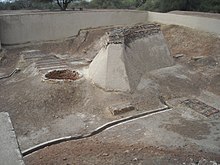
| An early sewage system, found in Harappa, consisting of a large well and bathing platforms. |
These simpler sewage systems were fine for small cities, but as the population grew during the Industrial Revolution, the streets became polluted, because the sewage system simply couldn't keep up. Cities were concerned about public health, as outbreaks of disease such as typhoid and cholera became more common. In the mid-19th century, Joseph Bazalgette, a British civil engineer, was asked to design a new system for London. He constructed almost 100 miles of sewage pipes, which grew even larger between 1859 and 1865. The construction of the new system required 318 million bricks, 670,000 cubic meters of concrete and 2.7 million cubic meters of excavated earth.
In the late 19th century, cities began implementing chemical treatment into their sewage systems. In the US, the first sewage treatment facility to use chemical precipitation was built in 1890 in Worcester, Massachusetts. The implementation of sewage treatment plants has drastically decreased outbreaks of water-borne diseases, and are an important factor in the increase in life expectancy.

No comments:
Post a Comment